
Short answer
No, $10,000 is not enough for a real bathroom remodel in Milwaukee. In 2026, that budget usually covers cosmetic touch-ups when you hire a licensed contractor: a new vanity and toilet, refreshed flooring, paint, fixtures, lighting, and a tub reglaze or basic insert, on a 5x7 to 5x8 footprint. Most bathroom remodels with us start around $15,800, and full gut renovations with tile showers, moved plumbing, and custom finishes run about $23,000 to $39,000. Knowing which tradeoffs to make is what stretches the budget. For a quick planning number, try our bathroom cost calculator.
Key takeaways
- A $10,000 budget buys cosmetic touch-ups on a small Wisconsin bathroom in 2026, not a remodel.
- Plumbing relocation, tile showers, and custom vanities push costs past $18,000 fast.
- Labor runs 40 to 60 percent of any Milwaukee bathroom remodel total.
- Bathroom remodels in the Milwaukee market recoup about 37 to 72 percent at resale, per Zonda's 2025 Cost vs. Value Report.
- Your municipality decides when a permit is needed, and paid plumbing work must be done by a licensed plumber.
- Prioritize one statement upgrade and keep the layout intact to stretch a $10K budget.
What $10,000 covers in a Wisconsin bathroom
A $10,000 contractor-installed cosmetic update in Wisconsin typically covers a new vanity, toilet, flooring, fixtures, lighting, and a basic tub or shower update on a 5x7 to 5x8 footprint.
That budget works best when the layout stays the same. Moving a toilet or shower drain means opening the floor and rerouting plumbing, which can add $1,500 to $3,000 before you buy a single tile. Keep the fixtures where they are and your money goes toward finishes instead of rough work.
Here is a realistic line-item breakdown for 2026 Milwaukee and Waukesha County pricing. Stock vanities deliver the biggest visual change per dollar in a tight budget.
| Item | What You Get | 2026 Installed Cost |
|---|---|---|
| Vanity, sink, and faucet | Stock 30-36 in. vanity, undermount or drop-in sink, mid-grade faucet | $900 - $1,800 |
| Toilet | Elongated comfort-height, installed and set | $400 - $700 |
| Flooring (35 sq ft) | Luxury vinyl plank or 12x12 porcelain tile | $1,200 - $2,400 |
| Tub or shower update | Reglaze existing tub or install acrylic tub-shower insert | $1,500 - $4,500 |
| Lighting, mirror, hardware, paint | New fixture, framed mirror, towel bars, fresh paint | $800 - $1,500 |
| Labor and minor plumbing | Demo, install, small supply or drain work | $2,500 - $4,000 |
| Permits and disposal | City or county permit, haul-away fees | $200 - $500 |
| Total range | $7,500 - $15,400 |
The low end assumes stock materials, no tub-shower swap, and no surprises behind the walls. The high end reflects tile flooring, a full acrylic insert, and a few extra hours of plumbing labor. That scenario is common in older Wauwatosa or Milwaukee homes built before 1970.
Warning
Bathroom humidity condensing in unventilated walls during Wisconsin cold snaps can crack grout lines and loosen subfloor panels. A common rule of thumb is 1 CFM per square foot; a 40-square-foot bath needs at least a 50 CFM fan. Wisconsin SPS 323 requires that fan to exhaust outside the building. If your existing floor flexes when you walk on it, budget $400 to $800 extra for subfloor repair before any new tile goes down.
The tub or shower line has the widest spread in that table. A reglaze runs $500 to $900 for materials and a few hours of labor. A full acrylic insert from American Standard or Kohler, properly set and caulked, can push $2,000 to $4,500 installed. That one decision shapes whether $10,000 feels tight or comfortable.
For how bathroom work fits into a larger plan, our bathroom remodeling page explains what the full service includes.
Where the money goes: a full cost breakdown
Labor consumes 40 to 60 percent of a Wisconsin bathroom remodel, fixtures and finishes about 30 percent, and permits, disposal, and contingency the remaining 10 to 15 percent.
That split shows you where flexibility actually exists. You can shop for a less expensive vanity. Cutting labor without cutting scope is much harder.
| Cost Category | Low End | High End | Notes |
|---|---|---|---|
| Labor (demo, install, tile, finish) | $4,000 | $6,000 | Largest single line item |
| Fixtures and finishes (vanity, toilet, tub/shower, tile) | $3,000 | $4,500 | Biggest place to save or splurge |
| Plumbing rough work, no relocation | $400 | $1,200 | Relocation adds $1,500 or more |
| Electrical (GFCI, vent fan, lighting) | $300 | $900 | Required under Wisconsin SPS 316 |
| Permits, municipal fees | $150 | $400 | Waukesha and Milwaukee County vary |
| Disposal and haul-off | $150 | $300 | Often bundled with demo labor |
| 10% contingency reserve | $1,000 | $1,000 | Non-negotiable on any remodel |
At the low end, those numbers add up to roughly $9,000. At the high end, you are already at $14,300. That gap explains why $10,000 only works for cosmetic touch-ups, and why a real remodel needs more.
Tile setters and plumbers in the Milwaukee market book 4 to 6 weeks out in spring and summer, so labor cost is also a scheduling constraint, not just a budget line.
Warning
Skipping the contingency reserve is the most common mistake homeowners make. Behind-the-wall surprises such as rotted subfloor or outdated wiring are routine in Milwaukee homes built before 1980. Budget $1,000 minimum as a buffer before you spend a dollar on finishes.
Cost per square foot in 2026
Full bathroom remodels run about $91 to $325 per square foot with us, which is Angi's 2026 national range of $70 to $250 plus 30 percent. A 40-square-foot bathroom sits near the top of that range because fixed costs do not shrink with the room, so plan on about $13,000 at the least, and most remodels with us start around $15,800. At $10,000 you are looking at cosmetic work with the plumbing left in place.
The most expensive parts of a bathroom remodel
The shower or tub replacement is the single most expensive part of most bathroom remodels, followed by tile work and plumbing relocation. Custom tile showers are the line item most likely to break a $10,000 budget. Knowing where money drains fast helps you protect your $10K cap before a single tile is set.
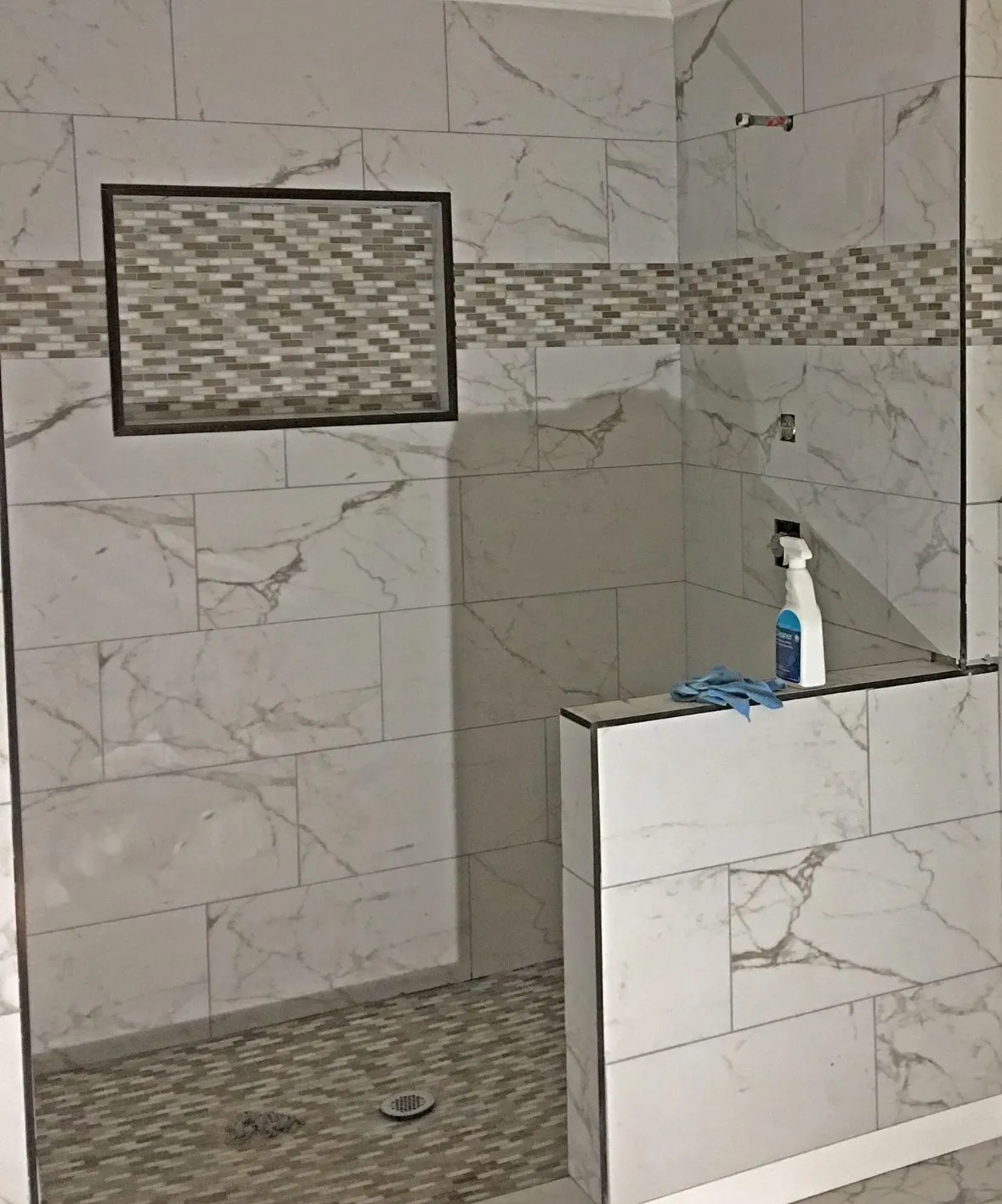
A tub-to-walk-in-shower conversion is the most common budget buster. A prefab acrylic unit runs $3,000 to $5,500 installed. Custom tile work jumps to $8,000 to $15,000 once you add a linear drain, niche shelving, and a frameless glass enclosure. On a $10,000 total budget, a custom shower alone leaves nothing for anything else.
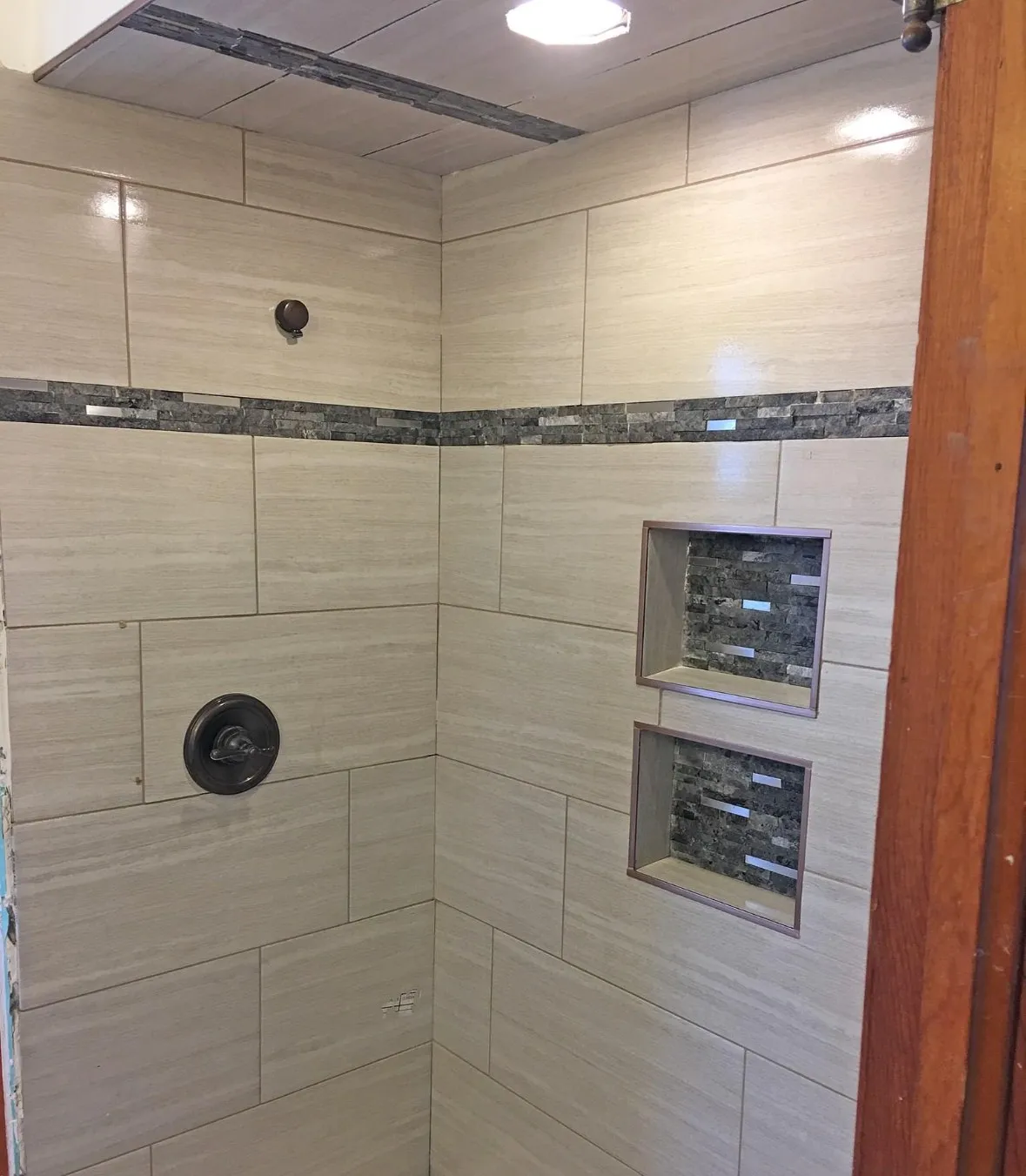
Retiling an existing shower surround costs $1,500 to $4,500, roughly $10 to $25 per square foot installed in 2026. Porcelain and ceramic sit at the lower end. Large-format stone tile and heated floor systems push toward the top.
Our crew pulled a shower pan last spring in a 1968 Brookfield ranch and found the subfloor had been wet for years. The homeowner had no idea. Catching that early saved a much larger repair bill, but it also pushed the project budget up by $1,100 before a single new tile went in.
Plumbing relocation
Moving a drain, shifting a toilet, or relocating supply lines takes the job past cosmetic work and past a $10,000 budget. Expect $1,500 to $3,500 just for the plumbing rough-in, before any tile or fixtures go back in. Leave the layout alone and you keep that money. Move it and plan for a larger budget.
Warning
Wisconsin law (Wis. Stat. 145.06) requires a licensed plumber for paid plumbing work such as moving drain lines. Hiring an unlicensed handyman to save money here can trigger failed inspections, code violations, and costly tear-outs later.
Vanities and enclosures
A stock vanity with a laminate top runs $400 to $900 installed. Step up to a semi-custom cabinet with a quartz top and you are looking at $1,800 to $4,000. That difference alone is $1,000 to $3,000 that could go toward better tile or a quality faucet set.
A frameless glass shower enclosure adds $1,200 to $2,500 to your project. It looks sharp, but it is a finish upgrade, not a structural need. On a tight budget, a simple rod-and-curtain setup or a basic framed door recovers real money.
Why labor costs more than the materials
Demo, waterproofing membrane, backer board, and licensed trade time routinely account for 50 to 60 percent of a bathroom remodel invoice. The materials on the shelf at a big-box store look affordable. The skilled labor to install them correctly in a wet environment is what drives the final number.
What to prioritize to stretch a $10,000 budget
Keep the existing layout, choose stock fixtures, and pick one statement upgrade. Those three decisions can make a Milwaukee bathroom remodel look like it cost twice as much.
The single biggest budget killer is moving plumbing. Leave the toilet, vanity, and tub or shower exactly where they are and you avoid $1,500 to $3,500 in rough-in labor right away. That money goes toward finishes instead of drywall patches and pipe rerouting.
Swap smart on surfaces
If your tub is structurally sound, reglazing it costs $400 to $600 and makes it look new. Replacing that same tub runs $2,500 to $4,000 installed. That one decision alone can fund your lighting upgrade and new vanity faucet.
For shower walls, Kohler Sterling acrylic wall surrounds install in a day and cost $600 to $1,200 installed. Custom tile on the same wall runs $1,800 to $3,500 once you factor in backer board, grout, and labor.
Flooring is another strong value play. Luxury vinyl plank (LVP) runs $3 to $5 per square foot installed versus $8 to $14 for porcelain tile. In a 60-square-foot bathroom, that difference puts $300 to $540 back in your pocket. Quality LVP is waterproof at the plank surface, which makes it more forgiving than laminate in a bathroom. Confirm the product you choose is rated for wet areas and that seams are properly sealed.
Spend on what people touch
A stock vanity from a home center costs $250 to $600. Pair it with a Delta Trinsic or Moen Genta faucet in brushed nickel, which runs $150 to $250, and a $200 to $350 vanity light bar, and guests remember the hardware, not the cabinet box. That is the one-statement-upgrade rule in action.
For walls, a mold-resistant Sherwin-Williams Emerald Interior in an eggshell finish costs $80 to $120 and holds up well in high-humidity bathrooms.
Tip
DIY the demo, paint, and accessory installs (towel bars, mirror, toilet paper holder). Hire licensed tradespeople for anything touching plumbing or electrical. Wisconsin SPS 382 and SPS 316 govern those scopes, and local inspectors check permits.
A simple stretch-your-budget process
- Confirm layout stays put. Walk through the plan with your contractor before signing anything. If a wall or drain moves, the budget changes fast.
- Price out reglaze vs. replace. Get one reglazing quote before you commit to a new tub or shower base.
- Choose stock, then upgrade one item. Pick your splurge (faucet, lighting, or mirror) and hold the line everywhere else.
- DIY the paintable work. A fresh coat of mold-resistant paint costs $80 to $120 in materials and transforms the room.
- Know when to stop. If the full scope runs past $10,000, it has become a remodel, so plan for one instead of cutting waterproofing or ventilation.
Working with a smaller number? Our guide to bathroom renovation on a $5,000 budget shows what a cosmetic-only refresh can include.
Want to know what your bathroom needs?
Free on-site walkthrough, then a written scope and quote before any deposit.
Timeline, permits and Wisconsin code requirements
A cosmetic $10,000 Milwaukee bathroom update typically takes 2 to 3 weeks from demo to final inspection.
Your municipality decides when plumbing and electrical work needs a permit, and paid work must be done by licensed trades. Skipping permits to save money creates real risk. If you sell your home or file an insurance claim with State Farm, American Family, or Allstate, unpermitted work can kill a deal or void coverage. Waukesha County inspectors do check, and retroactively permitting and correcting work almost always costs more than the original permit fee.
Here is how a typical project moves from demo to done:
- Demo and prep: The crew strips out fixtures, tile, and drywall. This takes 1 to 2 days. Surprises such as mold or rotted subfloor surface here, so budget a contingency before work starts.
- Plumbing and electrical rough-in: Licensed plumbers and electricians run new lines or modify existing ones. Plan for 2 to 3 days. Your municipality decides whether relocating a drain or supply line needs a permit, so check before the work starts. Adding a circuit can need an electrical permit too, and your local building office can tell you about smaller changes like moving an outlet.
- Flooring and vanity install: Tile setting, cement board, and vanity placement happen here. Allow 2 to 3 days. Tiles larger than 12x24 inches require more careful layout and leveling, which can add half a day to a full day on a standard bathroom floor.
- Tub or shower install and trim-out: The tub, shower pan, or prefab unit goes in, followed by valve trim, fixtures, and glass doors. This phase runs 2 to 4 days depending on complexity.
- Punch list and final inspection: The inspector signs off on plumbing and electrical. Plan 1 to 2 days for touch-ups, caulking, and confirming everything works correctly.
Warning
Wisconsin SPS 323 requires exhaust fans to vent air to the outside of the building, not into an attic or wall cavity. A fan venting into an attic is a code violation and a moisture problem waiting to happen, especially through a Wisconsin winter freeze-thaw cycle.
Two code items every Waukesha and Milwaukee homeowner should know before signing a contract:
- GFCI protection: Wisconsin SPS 316 requires GFCI protection on every receptacle in a bathroom, with no distance exception.
- Vent fan exhaust: Must terminate outside the structure under SPS 323, full stop.
A contractor who skips these items leaves you with liability, not savings. For which jobs need a permit and which do not, see bathroom remodel permits in Wisconsin.
Is a bathroom remodel a good ROI in Milwaukee?
Yes, a midrange bathroom remodel recoups about 72 percent at resale in the Milwaukee market and about 80 percent nationally, per Zonda's 2025 Cost vs. Value Report.
Zonda's 2025 Cost vs. Value Report puts a midrange bathroom remodel at 71.6% of cost recouped in the Milwaukee market. In that report, a $29,031 midrange job in Milwaukee kept about $20,797 in resale value. Not a dollar-for-dollar return, but strong enough to justify the spend if you plan to sell within a few years.
Key stat
Zonda's 2025 Cost vs. Value Report shows a midrange bathroom remodel in the Milwaukee market returns about 72 cents on the dollar at resale, making it one of the better-performing interior projects in the Milwaukee metro.
Cosmetic updates give you the best return per dollar spent. Swap out a dated vanity, replace a builder-grade mirror with a framed one, add new lighting, and repaint the walls for $2,000 to $4,000 and you still move the needle for buyers. You are not changing the layout or touching plumbing, so labor costs stay low.
Full luxury remodels with heated tile floors and a freestanding soaking tub can reach $39,000 and up. They raise your total home value more in dollar terms, but the percentage return drops because the spend is so high. For most Wauwatosa and Brookfield homeowners, a clean mid-range update beats an over-the-top luxury job on pure ROI math.
In the Milwaukee market, buyers and their inspectors pay close attention to one thing national ROI data does not capture: ventilation. Lake Michigan humidity means bathrooms in Milwaukee, Mequon, and Pewaukee get scrutinized hard for exhaust fan sizing and waterproofing. A bathroom with a properly sized exhaust fan, solid tile surround, and no mold staining signals a well-maintained home. Skipping that work to save money can hurt your sale price more than it saves you.
The short version: $10,000 in cosmetic updates can be a reasonable investment in the Milwaukee metro, especially when the money goes to visible upgrades, a properly vented exhaust fan, and solid waterproofing rather than luxury finishes you will not fully recover at resale.
When to spend more than $10,000
Hire a licensed contractor when the project involves wall removal, shower pan replacement, or any change to your electrical panel or drain lines.
Signs you need a bigger budget
Some problems make $10,000 disappear before a single tile goes up. If your contractor finds any of these during demo, expect your number to climb fast.
- Soft or spongy subfloor: Water has already rotted the OSB or plywood. Subfloor replacement in a standard bathroom runs $400 to $900 in labor and materials before anything else starts.
- Visible mold behind walls or under the pan: Remediation in a small bathroom runs $500 to $2,000 depending on how far it has spread.
- Cast-iron drain lines: Older Milwaukee and Wauwatosa homes often have cast iron. Replacing a single drain stack section can add $1,200 to $2,500.
- Undersized or missing vent fan: A common rule of thumb is 1 CFM per square foot; a 40-square-foot bath needs at least a 50 CFM fan. Wisconsin SPS 323 requires that fan to exhaust outside the building. A bath without proper CFM ventilation will fail again inside five years.
Signs $10,000 is enough for touch-ups
This budget only works when the bones are good. If a licensed plumber confirms your drain and supply lines are sound and your layout stays put, $10,000 can cover touch-ups like new floor tile, a new vanity, updated fixtures, and a refreshed shower surround.
A guest bath or secondary full bath in a Brookfield or New Berlin colonial is often a strong candidate. The footprint is small, the plumbing is accessible, and the goal is cosmetic improvement, not a structural overhaul.
Common DIY mistakes that cost more later
Skipping the waterproofing membrane behind shower tile is the most expensive shortcut homeowners take. TCNA B412 and manufacturer installation specs for products like Kohler and American Standard both require a moisture barrier in wet areas. Missing or improperly installed waterproofing membrane is the most common reason our crew tears out showers in older Milwaukee homes. A failed shower pan can mean tearing out everything you just paid for.
Other common errors: pulling no permit on electrical work, installing a vent fan with too few CFMs for the room size, and using drywall instead of cement board in wet zones.
When the scope requires a licensed pro
Relocate a drain or add a circuit and you are in licensed-trade territory under Wis. Stat. 145.06 and 101.862, unless the owner exemption applies. Those are not optional permits. Beyond code, the practical reason to hire a licensed contractor for shower pan work is moisture control: a pan that fails silently can rot a subfloor for years before anyone notices. We have seen it in Brookfield ranches, Wauwatosa bungalows, and New Berlin split-levels alike.
If the scope involves any of those items, get a written estimate from a licensed contractor before pulling permits yourself. The permit sequence matters.
Plan your bathroom remodel with a written quote
Generations uses an in-house crew on bathroom projects, and every job starts with a written scope, written quote, and written warranty before any deposit changes hands. We are licensed in Wisconsin and pull every permit for our clients.
If you want to know what a bathroom remodel would add to your specific home value, Alexis can walk through it during a free in-home estimate. For the bigger picture, see bathroom remodel cost in Milwaukee or read about bathroom remodeling in Milwaukee.