
Short answer
No, $5,000 will not remodel a bathroom in Wisconsin, but it can pay for cosmetic touch-ups. Expect a new vanity, toilet, faucet, light fixture, paint, peel-and-stick or luxury vinyl floor, and updated hardware while keeping the existing plumbing and electrical layout. Moving drains, replacing a tub-to-shower conversion, or retiling a full surround turns the job into a real remodel, which usually starts around $15,800 with us. Smart prioritizing, doing demo yourself, and using mid-grade fixtures keeps a small 5x8 bath under budget. For a quick planning number, try our bathroom cost calculator.
Key takeaways
- A $5,000 budget covers a cosmetic refresh in a 5x8 bath, not a full gut.
- Keep the existing plumbing layout, moving drains can add $1,500 to $3,500.
- Mid-grade vanity, toilet, faucet, and LVP floor fit a 5K Wisconsin budget.
- Your municipality decides when altering plumbing or electrical needs a permit.
- Bathroom remodels in the Milwaukee market recoup about 37 to 72 percent at resale, per Zonda's 2025 Cost vs. Value Report.
- DIY demo and painting can save $800 to $1,200 in labor on a small bath.
What $5,000 covers in a bathroom
Only as cosmetic touch-ups in a 5x8 or 5x10 bathroom. That budget covers new fixtures, paint, flooring, and hardware as long as you keep every pipe and wire exactly where it is.
That distinction matters. A cosmetic refresh means you update what you see without moving a single pipe or wire. A full remodel means relocating the toilet, tub, or vanity, and that work alone can push costs past $15,000 before you buy one tile.
The $5,000 number works best for the standard bathroom size in most Milwaukee bungalows and Waukesha County ranch homes built before 1990. Larger master baths have more square footage to tile, more wall to paint, and often need bigger vanities, so the budget runs short fast.
Key stat
Labor typically eats 40 to 65 percent of any bathroom remodel budget. On a $5,000 project, expect $2,000 to $3,250 to go toward skilled trades before a single product is purchased.
A 36-inch stock vanity shipped from a national distributor to a Milwaukee zip code typically adds $60 to $90 in freight versus a Chicago or Minneapolis delivery. That gap matters when a contractor is already scheduled and you are holding a tight budget.
The single biggest cost saver is keeping the existing layout. Moving a toilet just 12 inches requires a licensed plumber, a new drain rough-in, and a permit. That one change can cost $800 to $1,500 by itself.
Wisconsin code reference: SPS 382 covers plumbing changes (check local permit rules). SPS 316 covers electrical changes (check local permit rules). SPS 321 covers structural or framing changes (check local permit rules). Like-for-like cosmetic swaps require no permit.
Where the money goes: a real Wisconsin cost breakdown
A standard two-to-three day cosmetic refresh in a Milwaukee-area bathroom breaks down across six line items, and most jobs land between $4,800 and $5,400.
| Item | Low Estimate | High Estimate | Notes |
|---|---|---|---|
| Vanity (30-36 in.) with top | $350 | $700 | Stock units at Home Depot or Menards; includes sink top |
| Toilet (Kohler or American Standard) | $200 | $400 | Includes installation labor |
| Faucet and shower trim swap | $250 | $500 | Fixture cost plus one to two hours of plumber time |
| LVP or peel-and-stick floor (40 sq ft) | $300 | $900 | Waterproof LVP runs $4 to $9 per sq ft installed |
| Paint, mirror, hardware, accessories | $300 | $500 | Two coats, new towel bars, updated mirror |
| Skilled labor (2 to 3 days) | $2,200 | $3,200 | Finish carpenter plus licensed plumber if any supply or drain connections are disturbed |
| Total | $3,600 | $6,200 | Most jobs land near $4,800 to $5,400 |
A 10 percent contingency line is not optional. Soft subfloor or corroded supply lines behind the wall are common in Milwaukee homes built before 1980, and repairs add $300 to $800 before any new material goes down.
Warning
If your existing subfloor has soft spots or water damage under the old flooring, repairs add $300 to $800 before any new material goes down. Soft subfloor spots are common enough in Milwaukee-area bathrooms built before 1980 to budget for even when they are not visible from the surface.
Labor is typically your largest line item. A two-day refresh by a qualified crew in the Brookfield or New Berlin area runs $2,200 on the low end in 2026. Hiring an unlicensed handyman for plumbing connections can violate Wis. Stat. 145.06 and may affect the manufacturer warranty on the fixtures.
Tip
Keeping your toilet and shower valve in the same location saves $400 to $700 in plumbing rough-in time. Move nothing if you do not have to.
What to prioritize: where to splurge and where to save
Splurge on items that contact water daily: faucet, toilet, and vanity top. Save on paint, mirrors, and lighting, where mid-grade looks identical to premium at half the price.
Water-contact fixtures take the most abuse. A cheap faucet drips within two years. A low-grade toilet seal fails and rots your subfloor. Spending an extra $100 to $150 here prevents a $500 repair call later.
Quartz vanity tops run $80 to $150 more than laminate, but they resist staining, chipping, and humidity. Spread over 15 years, that premium works out to roughly $10 a year. Laminate looks fine on day one and tired by year five.
For toilets, the Kohler Highline or American Standard Champion hit the sweet spot at $250 to $350. Both carry solid flush ratings, easy-to-source parts, and warranties that hold. A $700 toilet adds nothing practical to a $5,000 refresh.
For faucets, mid-grade Moen and Delta fixtures carry lifetime warranties, and replacement parts are available at any plumbing supply house in Milwaukee. Spending $80 to $150 on a faucet from either brand is the right call. Spending $300 on a designer name buys you a finish, not better function.
Tip
One statement finish pulls a whole bathroom together. Matte black or brushed gold fixtures on faucet, towel bar, and toilet paper holder create a cohesive look for roughly $150 to $250 total. Mixing finishes randomly is what makes a budget bath look budget.
Big-box lighting and mirrors are where you save without sacrifice. A $60 vanity light from Menards and a $45 frameless mirror from Home Depot photograph nearly identically to $150 designer equivalents. Put that $200 difference toward your vanity top or toilet instead.
Milwaukee metro median home values currently run in the $270,000 to $310,000 range. A $5,000 refresh sits well inside the sensible remodel ceiling for that value range and protects your resale position.
| Item | Save Here | Splurge Here | Why |
|---|---|---|---|
| Vanity top | Laminate ($120-$180) | Quartz ($200-$330) | Durability, resale value |
| Toilet | Skip smart features | Kohler Highline / Am. Std. Champion ($250-$350) | Reliability, part availability |
| Faucet | Skip designer brands | Mid-grade Moen or Delta ($80-$150) | Warranty, drip resistance |
| Mirror | Big-box frameless ($40-$60) | Keep budget here | Looks identical to premium |
| Lighting | Big-box vanity bar ($50-$80) | Keep budget here | 40% less, same output |
| Finish accent | Pick one: matte black or brushed gold ($150-$250 total) | Commit to one finish | Ties the room together |
10 high-impact updates that fit under $5,000
The biggest visual wins on a $5,000 bath budget are a new vanity, fresh paint, modern lighting, LVP flooring, updated hardware, a low-flow toilet, a frameless mirror, and re-caulked tub lines. You do not need to gut a bathroom to make it look 10 years newer. Most of the updates below cost under $500 each, and several cost under $150.
- Paint the vanity instead of replacing it. A quality bonding primer plus cabinet paint runs under $80 in materials. Navy, sage, or charcoal reads as intentional and modern.
- Swap all hardware to one finish. Pick one finish, then replace every pull, knob, and towel bar. Budget $120 to $250 for the full set.
- Refinish the tub rather than replacing it. If your tub is structurally sound, a professional refinish runs $450 to $700 in 2026. Full tub replacement can cost $1,500 or more before any tile work begins.
- Install LVP over the existing subfloor. Luxury vinyl plank handles the high humidity and temperature swings in a Wisconsin bathroom better than hardwood or laminate, which can swell and buckle. Materials run $2 to $4 per square foot. Waterproof LVP with a 6-mil wear layer handles Wisconsin bathroom conditions best; check the spec sheet before you buy.
- Re-grout instead of retiling. Cracked or stained grout makes tile look far worse than it is. Re-grouting a standard shower surround runs $150 to $400 and takes a single day.
- Add a recessed medicine cabinet. Surface-mount models run $60 to $150; recessed models that cut into drywall run $120 to $250 installed. Either option adds real storage without eating floor space.
- Upgrade the exhaust fan to a quiet 1.0-sone model. A bathroom in a Milwaukee bungalow needs at least a 50 CFM exhaust fan. Most original installs are 30 CFM or less and cannot keep up with Wisconsin winter shower steam.
- Replace the toilet with a 1.28 GPF water-saver. A WaterSense-rated toilet costs $180 to $350 installed and cuts water use noticeably on your utility bill.
- Install one statement light fixture. Swap a builder-grade bar light for a single modern fixture above the mirror. Budget $80 to $200 for a fixture that anchors the whole room.
- Hang a frameless mirror. Large and frameless, it makes a small bathroom feel bigger and pairs cleanly with any vanity color or hardware finish.
Tip
Tackle hardware, paint, and mirror as one weekend project. Those three changes cost under $400 combined and create the biggest shift in how the room feels before a contractor ever shows up.
Want a straight number on your bathroom?
Free on-site walkthrough, then a written scope and quote before any deposit.
When to spend more: what $5,000 will not cover
Five thousand dollars will not cover a tub-to-shower conversion, full tile surround, moved plumbing, custom cabinetry, or heated floors.
Those upgrades turn the job into a real remodel, which usually runs $15,800 to $23,000 with us. A tub-to-shower conversion runs $4,500 to $8,500 on its own, before you add tile, a glass door, or new fixtures. A full tile shower surround adds another $2,800 to $5,500 in labor and materials, depending on tile size, layout complexity, and how much prep the walls need.
Ceramic subway tile on a straight layout costs less; large-format porcelain with a niche and bench costs considerably more.
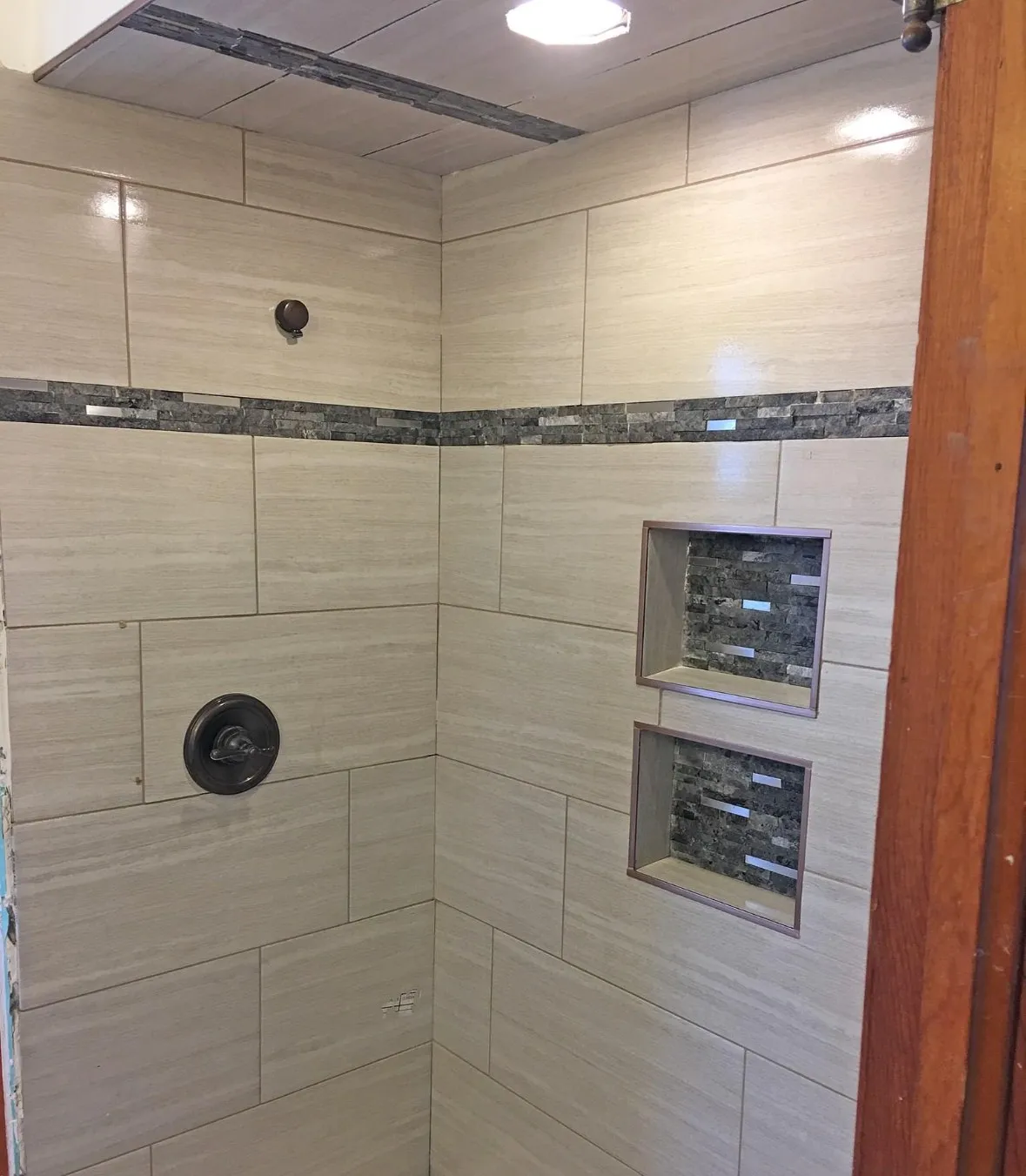
Moving a drain or vent stack is where costs climb fastest. Wis. Stat. 145.06 requires a licensed plumber for paid drain relocation work, and your municipality decides when you need a permit to alter plumbing or wiring. Budget $1,500 to $3,500 for that work alone, plus inspection fees.
Other upgrades that push past $5,000:
- Custom vanity with soft-close drawers: $1,800 to $4,000 installed
- Heated tile floor with programmable thermostat: $900 to $1,800 (popular in Mequon and Brookfield homes with cold tile winters)
- GFCI outlet addition: $150 to $350
- Electrical panel upgrade (if required): $1,500 to $3,000
Warning
If a contractor quotes you a tub-to-shower conversion, full tile surround, and vanity replacement for $5,000 total, ask for a detailed line-item breakdown before signing anything. Lowball bids often hide costs in change orders once walls are open.
The honest answer: $5,000 is a budget for surface touch-ups, not a remodel. If your wish list includes any of the items above, plan on $15,800 or more and work with a remodeler who hands you a written scope before work starts. A written scope before demo protects you from change-order surprises.
For the next step up, read what $10,000 covers in a bathroom, or see bathroom remodel cost in Milwaukee for full remodel ranges.
Timeline, permits and what to expect in Milwaukee
A $5,000 cosmetic bathroom refresh takes 3 to 5 working days. Permits are only required if you alter plumbing, electrical, or structural framing.
Most of what fits inside a $5,000 budget counts as cosmetic work: new flooring, a vanity swap, paint, lighting, and hardware. Those tasks rarely trigger a permit in Milwaukee or Waukesha County as long as you replace fixtures in the same location without moving drain lines or rewiring circuits.
Here is how a typical project runs:
- Demo and haul-away. The crew pulls the old vanity, mirror, toilet, and any damaged flooring. Debris goes out the same day so the space is ready for new materials the next morning.
- Flooring, paint, and wall repair. Cement board or a waterproof membrane goes down first, then tile or luxury vinyl plank. Walls get patched, primed, and painted while the floor adhesive cures.
- Vanity, toilet, light fixture, and trim install. New fixtures go in on day three. A like-for-like toilet swap connects to the existing flange and supply line, so no permit is needed.
- Punch list, caulk, and hardware. Days four and five cover the details: caulk lines at the tub surround, towel bars, toilet paper holder, door hardware, and a final walk-through with you.
Warning
If your project moves a drain, adds a GFCI circuit, or touches the vent stack, you need a licensed plumber or electrician unless the owner exemption applies, and your municipality decides if a permit is needed. SPS 382 covers plumbing (all supply and drain work). SPS 316 covers electrical (wiring, circuits, and GFCI requirements). SPS 321 covers general construction (structural framing and building envelope). Skipping permits on those scopes can stall a home sale and void homeowner's insurance claims.
Permit fees in Milwaukee typically run $75 to $200 for a single trade. Milwaukee permit applications go through the Department of Neighborhood Services. Waukesha County municipalities each maintain their own building department. Your contractor should pull and manage all permits for you.
Are $5,000 bathroom touch-ups a good investment?
It can be. Zonda's 2025 Cost vs. Value Report shows a midrange bathroom remodel in the East North Central region, which includes Wisconsin, returns about 71 percent at resale.
A focused cosmetic update often beats a full gut remodel on return per dollar spent, simply because the total spend stays lower.
Key stat
Midrange bathroom remodels in the Milwaukee market returned 71.6% at resale in Zonda's 2025 Cost vs. Value Report.
A dated bathroom gives buyers a negotiating chip. A cosmetic refresh removes it. New vanity, updated lighting, fresh flooring, and a modern faucet accomplish what buyers want to see without the price tag of a full remodel.
Wisconsin's climate adds one more resale factor most homeowners overlook. Lake Effect humidity off Lake Michigan pushes moisture into poorly ventilated bathrooms year after year, producing mold staining, peeling paint, and warped cabinet doors. Buyers and home inspectors flag undersized exhaust fans as a resale red flag, and a working, code-compliant fan is one of the cheapest upgrades in a $5,000 budget.
When to hire a contractor vs. DIY the refresh
DIY paint, hardware, and accessory updates yourself. Hire a Wisconsin-licensed contractor for plumbing connections, electrical work, flooring over an uneven subfloor, and any work touching the water supply or drain.
What you can safely DIY
Paint, new cabinet hardware, a framed mirror swap, towel bars, a light fixture swap (if the box is already there), and peel-and-stick vinyl floor tiles all fall into this category. Done well, these changes make a dated bathroom look years newer without touching a single pipe.
What needs a licensed pro
- Plumbing rough-in or pipe modification: Wis. Stat. 145.06 requires a licensed plumber for paid work on supply or drain lines, with exceptions for minor repairs and for owners working in a one-family home they live in.
- GFCI circuit installation: SPS 316 requires GFCI protection on every bathroom receptacle and on receptacles within six feet of a sink. This is permit-pulled electrical work.
- Tile shower pans: A pan sloped incorrectly traps water and rots the subfloor beneath it. A licensed installer sets the slope and waterproofs it correctly.
- Exhaust fan ducting: A fan vented into the attic instead of outside creates a moisture problem, especially through Milwaukee and Waukesha winters.
Why a pro install pays for itself
Licensed work preserves manufacturer warranties that DIY installs can void. Many waterproofing manufacturers, including some tile-system brands, require licensed installation to honor the warranty; confirm the specific terms before you start. Code-compliant work also prevents costly corrections at resale inspection.
Tip
Before you buy a single tile or fixture, confirm whether your project needs a permit. In Waukesha County and most Milwaukee suburbs, plumbing and electrical work require permits even inside an existing bathroom. A permit protects your home sale down the road.
Plan it with a written quote
Our in-house crew handles bathroom projects in Milwaukee, Wauwatosa, Brookfield, and Waukesha County, and work that needs a state license goes to licensed tradespeople. Scope, quote, and warranty are written before deposit. Project lead Alexis walks every job before demo starts to confirm the scope matches what was quoted.
Generations is licensed in Wisconsin and pulls every permit for its clients. Our bathroom remodeling page shows what the service includes, and homeowners in the city can read about bathroom remodeling in Milwaukee.