Attic insulation directly affects your roof's performance, your home's energy efficiency, and your risk of ice damage every winter. We handle all three.
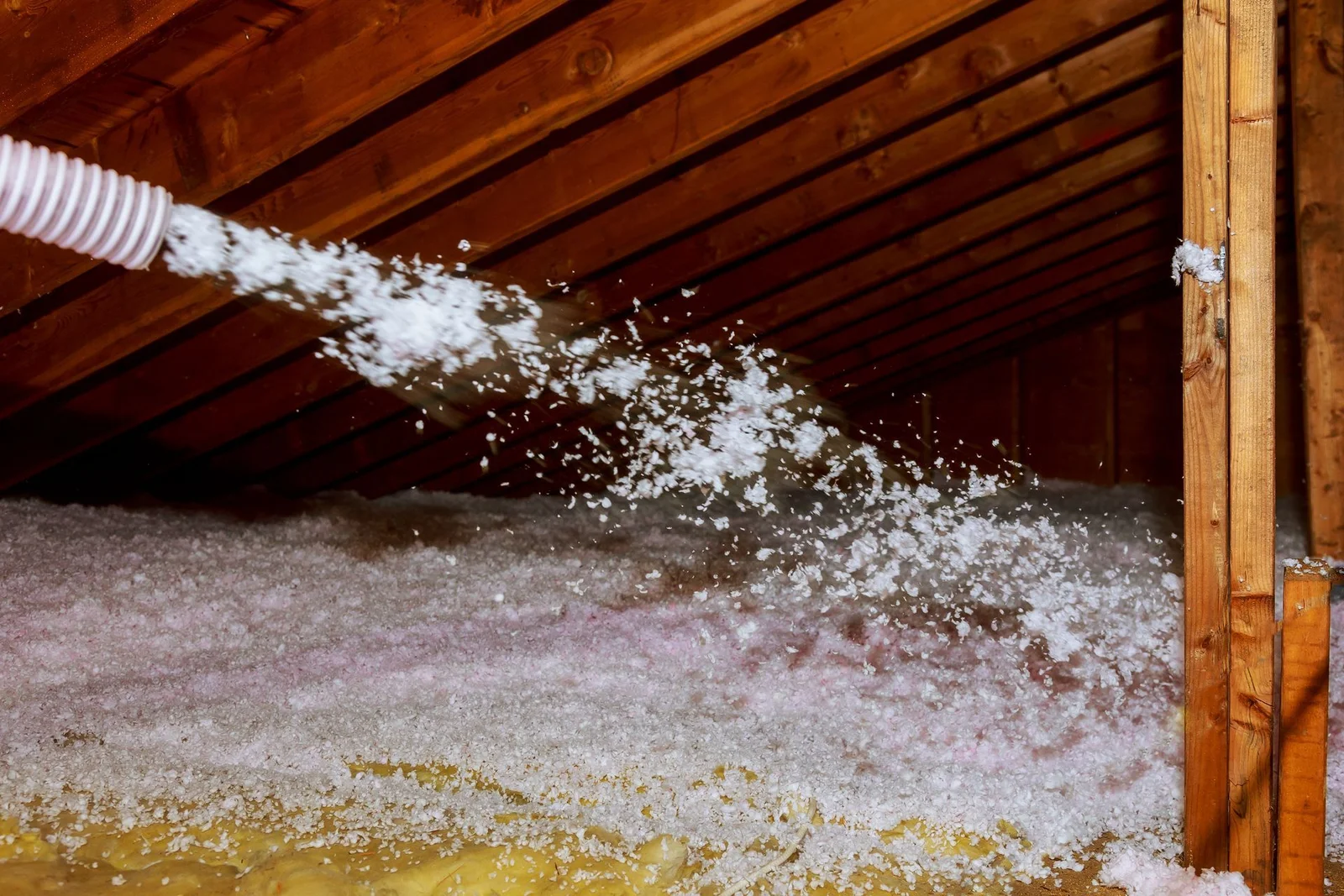
Most Milwaukee-area homeowners who call us about ice dams, inconsistent room temperatures, or energy bills that don't match their thermostat settings have the same underlying problem: an attic that isn't insulated to the level Wisconsin's climate demands. The connection isn't obvious until you understand the mechanics — and then it's unavoidable.
Heat generated inside your home rises. In a properly insulated attic, that heat stays in the living space below the insulation layer. In an under-insulated attic, it rises through the insulation, warms the roof deck above, and melts snow from the underside of the roof surface. That melt water runs toward the eave — where the roof deck is cold because there's no heat source below the overhang — and refreezes. That's an ice dam. It forces water back up under shingles, behind flashing, and into wall assemblies, damaging decking, degrading insulation further, and causing interior staining and mold growth.
A roof properly installed over an under-insulated attic will underperform its rated lifespan. Heat buildup in summer — compounded by poor ventilation — degrades shingles from the deck side. The manufacturer warranty doesn't cover premature failure caused by inadequate attic conditions. Insulation isn't just a comfort issue. It's a direct roof longevity issue — and it's why Generations handles attic insulation as part of our roofing service scope rather than treating it as a separate trade.
The Department of Energy divides the country into climate zones based on heating and cooling demands. Milwaukee sits in Climate Zone 6 — one of the most demanding zones in the continental United States. Most Milwaukee-area homes built before 1990 were insulated to standards that fell well below current recommendations.
Original fiberglass batt insulation installed at 4 to 6 inches — common in homes from the 1960s through 1980s — delivers approximately R-13 to R-19. That's less than half the current Zone 6 minimum. Those homes have been losing heat through the ceiling every winter since they were built.
Blown-in insulation also settles over time. A 12-inch depth of cellulose installed 20 years ago may have compressed to 8 or 9 inches, reducing its R-value by 20 to 30 percent. We measure existing insulation depth and assess condition before deciding on a solution.
Each of these symptoms points to a specific failure mechanism — not just general comfort issues. Knowing which one you're experiencing tells us where to look first during the assessment.
Repeated ice dams — particularly on roof sections that clear inconsistently compared to neighbors — are a reliable indicator of heat escaping through the attic floor. Ice forming heavily at the eave line while the upper roof remains snow-covered confirms the heat-loss mechanism. Addressing the insulation deficiency prevents the ice dam from forming rather than managing the damage after it does.
If you access your attic during a Wisconsin cold snap and see frost on the roof decking or rafters, warm interior air is bypassing the insulation layer through gaps around light fixtures, plumbing penetrations, or unsealed attic hatch perimeters. Frost on sheathing indicates both an insulation problem and an air sealing problem — the two almost always appear together in older Milwaukee-area homes.
Thermal bypasses in attic insulation show up as rooms that won't hold temperature regardless of what the thermostat says. Bedrooms directly below an under-insulated attic are cold in winter and hot in summer — not because the HVAC system is undersized, but because the thermal envelope has gaps the system is constantly compensating for.
When heating and cooling costs increase without corresponding changes in usage or utility rates, insulation degradation is among the first things to assess. A properly insulated and air-sealed attic reduces heating and cooling load — the system runs less often to maintain the same temperature. When the load increases, bills follow.
Material selection matters as much as depth. Each system has applications where it outperforms the others — and we specify the right material for each situation, not the easiest one to install.
Made from recycled paper fiber treated with a fire retardant, cellulose settles into irregular spaces and around obstructions more effectively than fiberglass. It's the preferred material for older Milwaukee homes where attic framing is non-uniform and batt installation would leave gaps. It also performs well as an added layer over existing degraded insulation when the base layer is still structurally sound.
Lighter density than cellulose, fiberglass blown-in is appropriate in applications where moisture control is a higher priority. It doesn't absorb water the way cellulose does and maintains more of its R-value in high-humidity conditions. Appropriate for attics where prior moisture events have been resolved but humidity management remains a concern.
Spray foam isn't appropriate for open attic floors in most applications — its cost per square foot makes it impractical for large areas, and its vapor barrier properties can create moisture problems if applied incorrectly. Where it makes sense:
Rim joists — the perimeter framing at the top of foundation walls — are one of the highest heat-loss areas in Milwaukee homes. Closed-cell spray foam applied at 2 inches to rim joists delivers approximately R-12 and seals the air bypass completely. Cathedral ceilings and finished attic knee walls, where there's no open floor cavity for blown-in, are also appropriate applications.
Attic knee walls, access hatch covers, and pull-down stair assemblies are typically insulated with faced fiberglass batt when the geometry allows. Attic hatch covers are among the most overlooked thermal bypasses in Milwaukee homes — an uninsulated hatch cover in an otherwise well-insulated attic is a significant heat loss point that takes approximately 30 minutes to address properly.
Adding insulation over an un-sealed attic floor delivers less than half its potential benefit. Heat doesn't only transfer through insulation — it moves through gaps. Air sealing those bypass points before blown-in insulation is installed captures the full benefit of both improvements.
Recessed light fixtures — a common and significant bypass in Milwaukee homes built before LED conversion
Plumbing stacks — penetrations through the top plate at each wet wall
Electrical penetrations — wiring passes through the ceiling plane at every junction box
Partition wall top plates — open cavities at interior wall tops communicate directly with the attic
Attic hatches — unweatherstripped hatch perimeters are a measurable heat loss point regardless of overall insulation depth
Air sealing isn't an optional add-on — it's a necessary step before additional insulation goes in. We identify bypass points during the assessment and include sealing scope in the written recommendation before any work is agreed to.
The combination of air sealing and insulation is what delivers the improvements homeowners are looking for — reduced ice dam frequency, lower heating and cooling costs, and more consistent room temperatures. Insulation alone, without addressing air bypasses, captures only part of the available improvement.
See how this connects to roofing energy savings →Every assessment starts before any material decisions are made. We access the attic, measure existing insulation depth at multiple points, check for moisture indicators on sheathing, assess ventilation, and identify air bypass points at penetrations and framing junctions. Assessment findings go into a written recommendation before any scope of work is agreed to or any deposit is collected.
We don't quote percentage savings figures because the variables — home size, construction, HVAC system, existing air sealing condition — are too home-specific to be accurate across a general range. Your written quote will be for your specific attic.
"They did our roof and also attic insulation. Absolutely amazing company, very friendly and do great work."
"The crew of Anthony, Luke, and Nicholas arrived on time, were very respectful and knowledgeable and did a great job."
"Very professional and respectful of my property, did everything extremely quickly, answered all of my questions thoroughly and in a timely manner."
Insulation and roofing are frequently done together for a specific reason: when a roof is being replaced, the deck is exposed and attic access is at its easiest. Any air sealing work at the deck level is done before new roofing goes on. Insulation improvements made at the same time as a reroof or replacement have no incremental disruption cost — one job, one scheduling window.
When attic insulation deficiency has caused ice dams that led to shingle damage or water intrusion under flashing, the insulation and the resulting roof damage often need to be addressed together. Fixing the roof without addressing the insulation that caused the problem means the same failure sequence repeats.
From Wauwatosa — right on the line between Milwaukee County and Waukesha County. Brookfield, West Allis, Greenfield, New Berlin, and every community in between. Alexis Quesada coordinates all scheduling.
Milwaukee & Waukesha County · Alexis responds personally
[INSERT_ELEMENTOR id="2969"]
This will close in 0 seconds
Ready for Your Free Estimate?
Roofing · Siding · Windows · Remodeling · Southeast Wisconsin